Home › Concrete Slab Foundations and Flatwork
Get a strong, level base for your project with professionally installed concrete slabs in Lexington, KY. We pour slabs for homes, garages, sheds, patios, and more with proper thickness, reinforcement, and vapor barriers. Our team handles site prep, forming, and finishing so your slab is ready for framing or equipment.
Superior Concrete Lexington provides professional concrete slab throughout Lexington, KY, Kentucky and the surrounding area. Our licensed, insured crew delivers safe, clean, on-time work with a free estimate before anything begins. Call (859) 710-8754 or request your free quote.
Concrete slab foundations and flatwork in Lexington that hold up to real life
Superior Concrete Lexington installs concrete slab foundations and flatwork that are built around Central Kentucky soil and weather, not a generic plan from somewhere else. Our crews work every week in Lexington clay, on sloped lots in neighborhoods like Hamburg, older areas inside New Circle, and rural properties in Fayette and surrounding counties. That experience matters because a slab that performs well on dry, sandy soil in another state will crack or settle differently in our expansive clay and freeze-thaw cycles.
When we talk about concrete slab work, we are usually dealing with three main types: house or building slab foundations, garage and shop slabs, and flatwork such as driveways, patios, sidewalks, and barn or pole building floors. Each one needs different thickening, reinforcement, and joint layouts. A patio slab that only carries foot traffic does not need the same edge depth or rebar pattern as a garage that will see a 3/4-ton truck every day. We design each pour based on how you will actually use it, the soil conditions on your property, and what local codes in Lexington and Fayette County require.
Instead of pushing one standard thickness or mix, we look at drainage around the site, access for equipment, and how future construction will tie into the slab. That might mean setting in conduit for power to an outbuilding, leaving sleeves for future plumbing, or planning a thickened edge where a load-bearing wall will sit later. Those decisions are what keep you from having to tear out and redo concrete a few years down the road.
How we build concrete slabs in Lexington from dirt work to final cut joints
A solid concrete slab in Lexington starts with proper site prep. First, Superior Concrete Lexington evaluates the existing grade and soil. If we find soft topsoil, organic material, or fill that was poorly compacted in the past, it has to be removed. We then bring in appropriate base material, usually dense graded aggregate (DGA) or crushed stone, spread it in lifts, and compact it with plate tampers or a roller until it meets the firmness we need. On house slabs or garage foundations, we may also perform a proof roll or spot compaction tests if required by your builder or engineer.
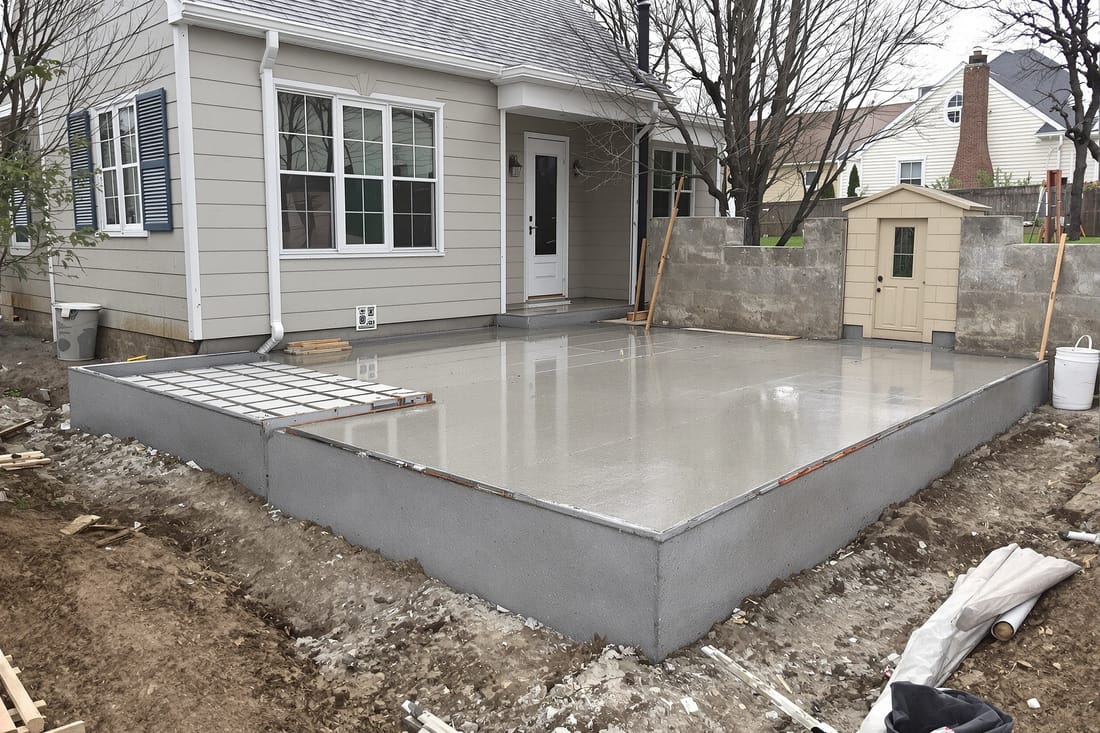
Next, we establish forms using straight lumber or metal forms and grade pins. Forms are set to the exact finished height so your slab will tie cleanly into thresholds, garage doors, or existing flatwork. In Lexington, you typically want at least a quarter inch of slope per foot on exterior slabs like driveways and patios so that heavy summer rains do not pond near your house or freeze as slick spots in winter.
Before concrete arrives, we install reinforcement. For most residential slabs, we use a grid of half-inch rebar or welded wire mesh, supported on chairs so it stays in the middle third of the slab, not lying on the ground. On heavier-use slabs such as RV pads, shop floors with lifts, or commercial entrances, we often increase the bar size or tighten the spacing and add thickened edges or interior footings under load points. If the slab will have plumbing or electrical, we coordinate with your plumber or electrician so that sleeves, stubs, and floor drains are correctly located and securely braced.
Once everything is ready, we schedule the pour around weather and temperature. Kentucky weather can change fast. We avoid pouring over saturated base or during hard freezes, and we adjust mix design and set times with the ready-mix plant based on forecast temperatures. During the pour, we place concrete starting at the lowest point, vibrate or rod around rebar and penetrations to remove air pockets, and screed to the forms. After bull floating, we allow bleed water to come up and evaporate before any finishing. Rushing this step is a common cause of weak, dusty surfaces, and it is something we are careful to avoid.
Control joints are either tooled during finishing or saw-cut at precise intervals, usually within 6 to 12 hours after the pour depending on conditions. For typical sidewalks and smaller patios in Lexington, joints might be spaced 4 to 5 feet apart. Larger slabs need a layout that matches the slab thickness, expected movement, and where walls or columns will go. These joints control where minor shrinkage cracks form, so a proper joint plan is one of the most important details of the job.
Material choices, finishes, and options for your slab or flatwork
Every concrete slab depends on the right mix and finish. Superior Concrete Lexington works with local batch plants to specify mixes that suit your project. Standard residential flatwork usually uses a 4,000 psi mix with air entrainment to handle Kentucky freeze-thaw cycles. For heavier use, such as garage slabs with vehicle lifts or commercial storage, we may step up the strength or add fibers in addition to rebar for extra crack control.
You also have choices on thickness and reinforcement. Typical Lexington sidewalks and patios are poured at 4 inches thick with wire mesh or a light rebar grid, while many garage slabs and driveways are 5 to 6 inches thick with tighter rebar spacing. If you plan to park a boat, camper, or work truck, we will recommend specific reinforcement patterns and thickened sections where wheels or jacks will sit. Discussing these details upfront keeps the slab from curling, cracking excessively, or showing wheel ruts.
Finish options depend on how you will use the space. Broom finish is most common for driveways, sidewalks, and standard patios because it provides traction in rain and when icy. For interior workshop slabs, basements, or covered porches, we may trowel to a smoother finish that is easier to sweep and seal. Decorative options include colored concrete integral in the mix, exposed aggregate for patios and walks, or stamped patterns that mimic stone or pavers. In Lexington neighborhoods with HOA guidelines, we can match or complement existing textures and colors so your new work passes architectural review without surprises.
Proper curing is another part of the material choice discussion. Concrete in Kentucky summers can dry out too quickly, which weakens the surface. We often use curing compounds or plastic sheeting, or we keep the slab damp for the first several days depending on the finish. For large slabs or high-visibility areas, we explain the curing plan in advance so you know what to expect on site and how long to keep people, pets, and vehicles off the new surface.
We also talk through sealer options. Exterior flatwork can benefit from a breathable sealer that helps resist deicing salts used on Lexington roads. Interior slabs that will remain exposed, such as in shops or basements, may need a different product that resists oil, spills, and tire marks.Choosing the right combination of mix, reinforcement, finish, curing, and sealer is what separates a slab that just looks good on day one from one that still performs ten or fifteen years later.
Costs, permitting, and what affects pricing in Lexington, KY
Pricing for concrete slab foundations and flatwork in Lexington depends on more than just square footage. Superior Concrete Lexington walks you through each item that drives cost so you can make clear decisions. The main factors are slab thickness, reinforcement type, site access, base preparation, and any required demolition or hauling.
For a new driveway or patio on an open, level lot with good access, costs are mostly concrete volume, reinforcement, labor, and finish work. If we have to remove old concrete, asphalt, or tree roots, that adds demolition and disposal. Tight backyards in older Lexington neighborhoods sometimes require smaller equipment or more hand work because we cannot fit a full-size skid steer or truck through side yards. That extra labor time changes the price.
Local permitting also plays a role. Inside Lexington city limits and Fayette County, the building department may require permits and inspections for structural slabs, additions, and new garages. For a simple residential patio or short walk, a permit might not be required, but anything tied to a new structure, room addition, or change in drainage usually is. We stay current with Lexington-Fayette Urban County Government requirements and are familiar with typical inspection points such as footing depth, vapor barrier placement for habitable space slabs, and reinforcing inspections when required by an engineer.
Soil conditions can add or reduce cost. If we find solid, undisturbed native soil, prep is straightforward. If the area was previously filled, or if we encounter poor draining clay pockets, we may recommend undercutting and replacing with compacted stone. This is not an upsell, it is often the difference between a slab that stays level and one that settles or heaves. On larger or more complex projects, your builder or architect may call for a geotechnical report, and we work from those recommendations.
We provide itemized written estimates that spell out thickness, reinforcement, finish type, and any special details such as thickened edges, vapor barriers, or drain installations. That way, when you compare quotes from different contractors, you can see who is actually providing the same scope instead of just comparing a lump sum number. Our goal is to help you understand exactly what you are paying for and where it makes sense to spend a little more to avoid future slab problems.
Common concrete slab issues and how Superior Concrete Lexington prevents them
Most slab problems we are called to fix in Lexington trace back to shortcuts. Subpar base prep, missing reinforcement, no control joints, or pouring in bad weather without adjustments are the usual culprits. Superior Concrete Lexington designs work to avoid those issues from the start.
Cracking is the most common concern. Some hairline cracking in concrete is normal because of shrinkage and temperature movement, but long, random cracks that open wide or create trip hazards are not. We reduce that risk with a combination of proper control joint spacing, adequate reinforcement, consistent slab thickness, and attention to curing. For example, on a 4 inch thick sidewalk, we keep joints reasonably close and at consistent depths, and we avoid placing them at sharp reentrant corners without extra steel. On house slabs, we follow engineering or code-based guidelines so that joints and steel work together instead of against each other.
Settlement and heaving are another problem in Central Kentucky. If a slab is placed on topsoil, mud, or un-compacted fill, the weight of the concrete and seasonal moisture changes will move it. Our crews remove unsuitable material and build up a compacted stone base, and if drainage is an issue, we can install swales, drain tile, or surface drains to move water away. Around Lexington, where clay can hold water, providing a path for water to go is one of the best protections for your slab.
Surface scaling, flaking, or spalling happens when concrete is finished while bleed water is still present, or when non air-entrained mixes are used in freeze-thaw conditions. To prevent this, we match the mix to our climate and do not hard trowel exterior slabs that will see deicers or frequent wetting and freezing. We also give you straightforward guidance about how soon to put deicing salt on new concrete (generally avoid it the first winter if possible) and how to maintain the surface.
If you already live with an older slab that has issues, we can evaluate whether repair, slabjacking, resurfacing, or replacement makes the most sense. For example, a settled front walk in Lexington can sometimes be lifted and stabilized instead of torn out, while a severely cracked and heaved driveway may be better replaced with proper base and drainage. Our recommendations are based on what will actually solve the problem long term, not just what is fastest to install.